Bush Fire Brigade Members Information and Forms
 Membership Registration Form - New and Existing
Brigade PPE Order Form
Farm Vehicle Fire Response Stickers
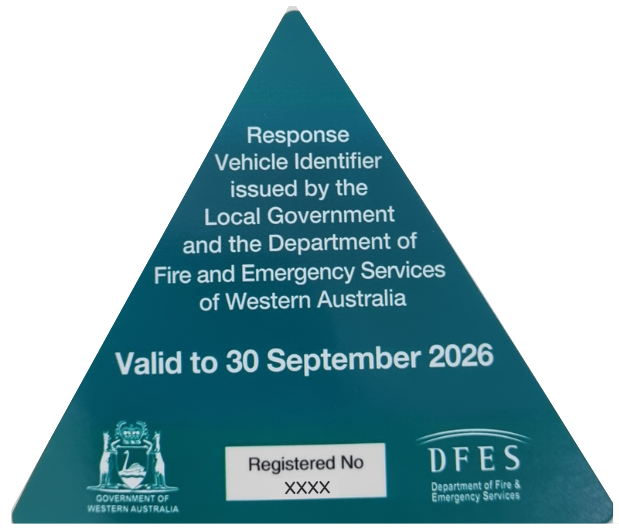 |
To help police to identify vehicles which can assist in a bushfire response, the Shire encourages owners of such vehicles or machinery to apply for a Fire Response Vehicle Identifier sticker.
The stickers are designed to enable passage of approved vehicles through the vehicle control points (road blocks) where approved by the Incident Controller.
Appliances or machinery without a Vehicle Identifier sticker may be delayed or prevented from assisting in the response.
The Fire Response Vehicle Identifier is for the purpose of fire response vehicles only.
Applicants must read and understand the "Operating Private Equipment at Bushfires" publication and return forms to [email protected] or PO Box 2, Boyup Brook WA 6244.
|
|
Stickers for the period ending 30 September 2028 are now available. Application forms are available from the Shire Administration Office or download HERE
Multiple stickers may be issued to persons with multiple suitable vehicles/equipment.
|
| Shire of Boyup Brook – Bush Fire Brigade Training Schedule 2026 |
| Training Title |
Training ID# |
Date |
Duration |
Start & Finish times |
Location |
| SEPTEMBER |
| Rural Fire Awareness |
26540914 |
Wednesday 16/09/2026 |
4-5 hours |
4:30pm – 9:30pm |
Wilga Hall |
| OCTOBER |
| AIIMS Awareness |
26545208 |
Monday 05/10/2026 |
|
4:30pm |
Shire of Boyup Brook |
| Rural Fire Awareness |
26541074 |
Wednesday 07/10/2026 |
4-5 hours |
4.30 – 9.30pm |
Shire of Boyup Brook |
| WAERN Basic Radio Use |
26545263 |
Wednesday 28/10/206 |
4-5 hours |
4.00pm |
Shire of Boyup Brook |
| WAERN Advanced Radio Use |
26546146 |
Wednesday 28/10/2026 |
4 hours |
6:00pm |
Shire of Boyup Brook |
| NOVEMBER |
| Rural Fire Awareness |
26546146 |
Wednesday 18/11/2026 |
4-5 hours |
19:00am |
Dinninup/Rhodes - TBC |
Course Descriptions and recommended Participants
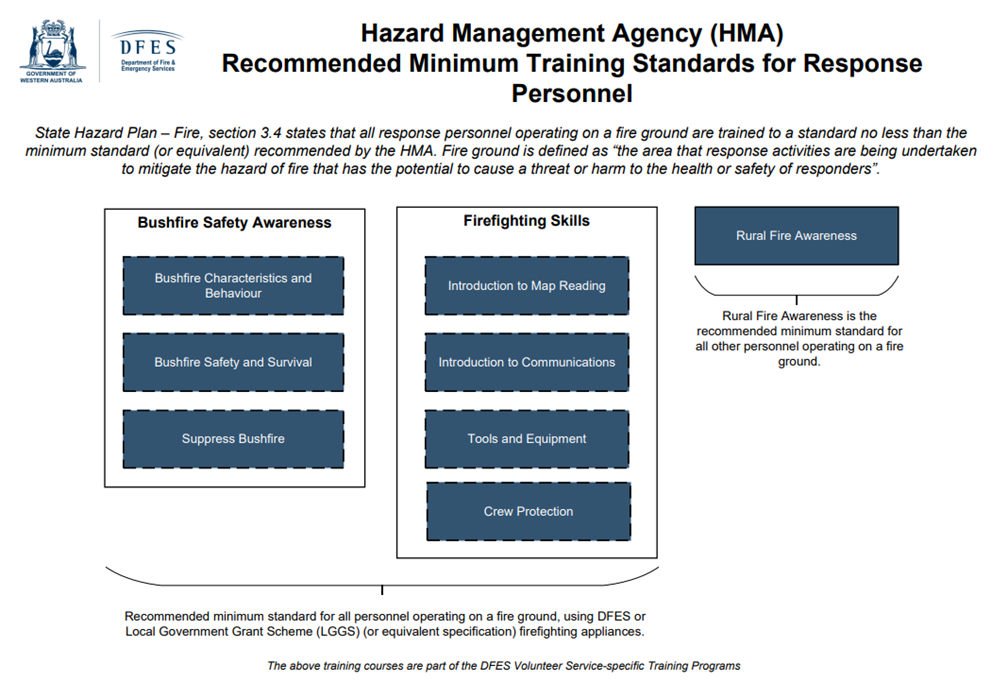
Rural Fire Awareness course provides essential training on fireground safety, suppression strategies, and personal safety for personnel supporting bushfire response. This course promotes safe practices for those operating in rural fire environments.
Rural Fire Awareness is the recommended minimum standard for all other personnel operating on a fire ground.
Suitable for:
- Farmer Response/Private Units
- Seasonal Workers
- Shire/Agency Staff
- Auxiliary members
- Local Contractors
- Anyone who could possibly find themselves in a bushfire situation!
Delivery Options:
- Face to Face – 4-5hrs – (includes refreshment and question time) Anyone can come.
- Online – eAcademy – DFES ID required – 2-3hrs
Bushfire Safety Awareness (BFSA) course is the foundational level of training provided by DFES. It is designed to ensure that anyone operating in a bushfire environment—whether as a firefighter, support member, or external agency staff—has a baseline understanding of fire behaviour and personal safety.
Completion of this course is the first step toward achieving the Firefighting Skills (FFS).
Suitable for:
- Farmer Response/Private Units
- Seasonal Workers
- Shire/Agency Staff
- Auxiliary members
- Local Contractors
- Anyone who wants to complete Fire Fighting Skills
Delivery Options:
- Face to Face – 2 Days – (includes refreshment and question time).
- Blended Online/Face to face option – 1 day plus online time.
Firefighting Skills (FFS) course is the next critical step in the DFES training pathway. While Bushfire Safety Awareness teaches you how to stay safe, Firefighting Skills teaches you how to actually engage and suppress a fire. It is a highly practical course designed to turn a trainee into a competent, operational firefighter.
Bushfire Safety Awareness and Firefighting Skills are the minimum standard for all personnel operating on a fire ground, using DFES or Local Government Grant Scheme (LGGS) (or equivalent specification) firefighting appliances.
Suitable for:
- Anyone who has completed Bushfire Safety Awareness and will be crewing an LGGS appliance (including high-season vehicles)
Delivery Options:
- Face to Face – 2 Days – (includes refreshment and question time). Practical Equipment Operations.
Fire Control Officer course. As an appointed FCO, a member must complete the DFES Fire Control Officer training pathway. The Fire Control Officer course is a foundation course covering Statutory Requirements, Incident Control Systems, Compliance (firebreaks & permits), Leadership & Management, managing volunteer dynamics and inter-agency cooperation (e.g., working alongside DFES Career staff or DBCA).
Suitable for:
- Current FCOs/DFCOs – as a refresher (recommended if you have not done the course in the past 3 years – there have been updates)
- Newly appointed FCOs and Deputy FCOs – mandatory within the season of appointment.
- Brigade member development – potential future FCOs
Delivery Options:
- Face to Face – 1 Day – (includes refreshment and question time).
Advanced Bush Firefighting (ABF) course is a key progression in the DFES training framework, bridging the gap between basic firefighting and leadership roles like Crew Leader. The foundational Firefighting Skills course teaches you how to use equipment, this course focuses on the "why" and "when"—deepening a firefighter's understanding of complex fire behaviour and more strategic suppression methods.
ABF is often viewed as the "technical prerequisite" for moving into a leadership stream. It provides the grounding needed for Crew Leader (Advanced Bush Fire): Taking charge of a single appliance and its crew, and Sector Commander: Coordinating multiple appliances within a specific geographic area.
Suitable for:
- To enrol in Advanced Bush Firefighting, members must typically hold:
- Bushfire Safety Awareness (BFSA)
- Firefighting Skills (FFS)
- A period of operational experience (often 12–24 months) to ensure the theory is grounded in fireground reality.
Target Audience:
- This course is strongly recommended for senior volunteer firefighters and is a pathway requirement for those looking to be appointed as a Fire Control Officer (FCO) or Chief/Deputy Chief Fire Control Officer.
Delivery Options:
- Face to Face – 1 Day – (includes refreshment and question time).
Crew Leader (CL) course is a pivotal leadership qualification within the DFES training framework. It marks the transition from being a supervised firefighter to being the person responsible for the safety of a crew and the tactical success of an appliance (truck).
In the field, the Crew Leader is the "boots on the ground" supervisor who translates orders from the Incident Controller or Sector Commander into direct action.
Suitable for:
- To undertake the Crew Leader course, members generally must have:
- Bushfire Safety Awareness (BFSA)
- Firefighting Skills (FFS)
- Advanced Bush Firefighting (ABF)
- Demonstrated Experience: A significant amount of operational "fireground time" to prove they have the maturity and technical knowledge to lead others.
AIIMS Awareness course is an entry-level program designed to introduce the Australasian Inter-service Incident Management System (AIIMS). It is the national "common language" used by fire, emergency, and land management agencies across Australia to manage incidents of all sizes and types. This course is often the very first requirement to complete before moving into operational fire training.
Suitable for:
- Farmer Response/Private Units
- Seasonal Workers
- Shire/Agency Staff
- Auxiliary members
- Local Contractors
Delivery Options:
- Face to Face – 3-4hrs – (includes refreshment and question time) Anyone can come.
- Online – eAcademy – DFES ID required – 1hr
Basic WAERN course (often integrated into Introduction to Communications) is for frontline responders who need to use handheld or vehicle-mounted radios during an incident.
- Radio Hardware: Identification of the different types of WAERN radios (usually Tait or Simoco brands) and their controls (volume, squelch, channel selector).
- Channel Selection: Understanding the difference between Regional Channels (for long-distance comms via repeaters) and Simplex Channels (for short-range, line-of-sight comms between trucks).
- Standard Voice Procedures: Learning the "Prowords" (e.g., Roger, Over, Out, Wait, Correction) and the phonetic alphabet to ensure clarity over the air.
- The "Red Button": Proper use of the Emergency Button and the protocols that follow an emergency trigger.
Advanced WAERN course is designed for those in leadership or support roles—such as Crew Leaders, FCOs, or Communications Officers—who need to manage more complex communication environments.
- Network Architecture: A deeper look at how the repeater network functions across Western Australia and how to troubleshoot "dead spots."
- Talkgroups & Multi-Agency Comms: How to patch into or communicate with other agencies (SES, VFRS, or DBCA) during a multi-agency response.
- Scanning & Monitoring: Techniques for monitoring multiple channels (e.g., a Fireground channel and a Divisional Command channel) without missing critical information.
- Strategic Comms: Managing radio traffic during high-intensity periods to prevent "stepping on" other users and ensuring the highest priority messages (SitReps and Emergencies) get through.
Suitable for:
- Farmer Response/Private Units
Delivery Options:
- Basic/Adv = Face to Face – 4-5hrs – (includes refreshment and question time).
Volunteer Hub Link for Volunteers: https://www.volunteerhub.dfes.wa.gov.au/
Bush Fire Brigade Relevant Legislation and Laws
Scan the QR code to read the legislation or law.
 |
 |
 |
 |
| Emergency Management Act 2005 |
Bush Fires Act 1954 |
CALM Act 1984 |
Fire Brigades Act 1942 |
 |
 |
 |
|
| FES Act 1998 |
SoBB BFB Local Laws 2005 |
Bush Fire Regulations 1954 |
|